
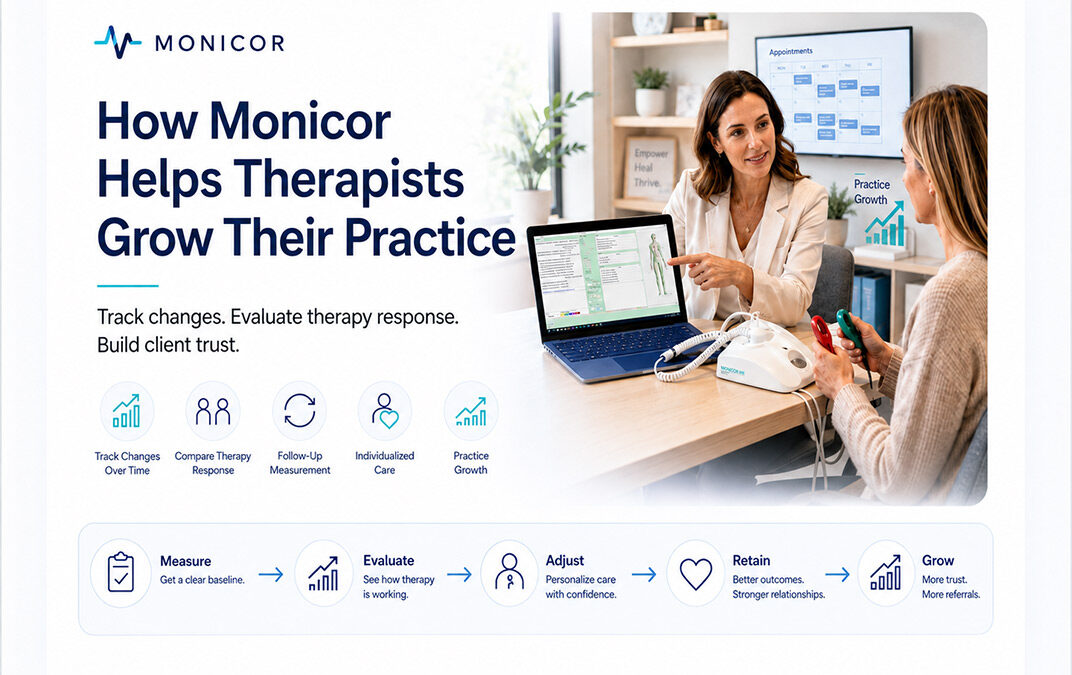
For many therapists, attracting new clients is becoming increasingly difficult.
People today have more choices than ever. They can compare therapists, clinics and wellness services online within minutes. At the same time, many practices offer similar treatments and describe their services in similar ways.
So the challenge is no longer only to provide a good treatment.
The challenge is also to answer a simple question:
Why should a client choose your practice — and why should they come back?
Monicor can help create a more structured, visual and individualized consultation process. It gives the therapist additional information to work with, while also making it easier for the client to understand what is being assessed, why a particular approach is chosen and how things may change over time.
This can influence not only the quality of the consultation, but also client retention, referrals and the overall attractiveness of the practice.
1. Start With a Clear Baseline
A client may come to a therapist because of fatigue, stress, poor sleep, low energy or simply because they want to improve their general well-being.
But many of these concerns are subjective.
The client can describe how they feel, and the therapist can make observations based on experience, but it may still be difficult to establish a clear starting point.
Monicor gives the practitioner an additional way to create a baseline assessment at the beginning of the process.
This first assessment becomes a reference point.
Instead of simply saying:
“Let’s begin the treatment and see how you feel.”
the therapist can create a more structured process:
Initial assessment → Therapy → Follow-up assessment → Comparison
This gives both the therapist and the client something to return to later.
And that leads to one of the most useful possibilities of Monicor: observing changes over time.
2. Follow the Dynamics of Change
A single assessment can provide useful information.
But repeated assessments can be even more valuable.
For example, a therapist may perform an initial Monicor assessment during the first consultation and then repeat it after several treatment sessions or a few weeks later.
The practitioner can then compare the results and look at how the measured parameters have changed.
Some areas may show a different pattern. Others may remain relatively stable. New areas may become more relevant.
The purpose is not simply to produce another report.
The purpose is to create a dynamic picture.
For example:
Visit 1 — Initial assessment
Visit 2 — After several therapy sessions
Visit 3 — Follow-up several weeks later
Now the conversation with the client can become more concrete.
Instead of saying:
“I think things are improving,”
the therapist can say:
“Let’s compare today’s assessment with the one we made three weeks ago.”
This creates a natural reason for follow-up visits while making the therapeutic process easier for the client to understand.
3. Observe Responses to Different Therapeutic Approaches
Many therapists use more than one method.
Depending on the practice, this may include massage, acupuncture, frequency-based therapies, breathing techniques, manual methods, relaxation programs or other wellness approaches.
But an important practical question remains:
How does this particular client respond to a particular approach?
Monicor can provide additional information by allowing the practitioner to compare measured parameters before and after different interventions.
A simple workflow may look like this:
Assessment → Therapy → Reassessment
Over time, the therapist may be able to compare how the client’s measured parameters change following different approaches.
This can provide useful additional information when planning future sessions.
The goal is not to claim that one measurement alone proves the medical effectiveness of a therapy.
Rather, Monicor gives the practitioner another way to observe, compare and discuss changes.
For an experienced therapist, this additional information can be valuable when deciding whether to continue with the same approach or consider an alternative.
4. Avoid Repeating the Same Therapy Automatically
One of the risks in any long-term treatment process is routine.
A client starts a program of several sessions, and the same treatment is repeated simply because that was the original plan.
But what if the client’s response changes?
What if one area improves while another becomes more important?
What if the original approach does not appear to be producing the expected changes?
Regular reassessment can help the therapist avoid working blindly.
A practical process might be:
Assessment
↓
Choose an approach
↓
Perform several sessions
↓
Reassess
↓
Compare
↓
Continue or adjust
This makes the process more flexible.
It also gives the client a different impression of the service.
Instead of:
“We always do ten sessions of the same treatment,”
the message becomes:
“We periodically reassess your situation and adapt the approach when necessary.”
That difference can significantly increase the perceived value of the consultation.
5. Make the Consultation More Individual
Two clients may arrive with very similar concerns.
Both may complain about tiredness. Both may have difficulty sleeping. Both may describe high levels of stress.
But that does not necessarily mean that the therapist should approach them in exactly the same way.
A Monicor assessment may highlight different patterns and different areas of attention for each person.
This creates a simple but important principle:
Same complaint does not necessarily mean the same approach.
For the therapist, this provides additional information for planning the consultation.
For the client, it makes the experience feel more individual.
The treatment is no longer presented as a standard protocol that everyone receives.
Instead, the therapist can explain why certain areas are being considered and why a particular approach has been selected.
That can increase engagement and make the client feel more involved in the process.
6. Compare Individual Responses to Supplements and Other Substances
Another practical possibility is substance testing.
Many clients already use vitamins, minerals, herbal products or other supplements.
But the same product does not necessarily produce the same response in every person.
Monicor can be used as an additional tool for comparing an individual’s response to different substances.
For example, a therapist may want to compare several products or formulations and observe how the measured response differs.
This can create another useful service within the practice:
individual substance or supplement testing.
For the client, this is much more specific than simply hearing:
“This is a good supplement.”
The consultation becomes focused on the individual rather than only on the general characteristics of the product.
For practitioners who already work with nutrition, supplements or wellness products, this function can add another dimension to the consultation.
7. Give Clients a Clear Reason to Return
Attracting a new client is important.
But building a successful practice also depends on whether clients return.
One of the easiest ways to lose a client is to leave the next step unclear.
After a treatment, the client may simply go home and think:
“I suppose I’ll book again if I need to.”
A monitoring-based approach creates a much clearer continuation.
For example:
Initial assessment → Therapy period → Follow-up assessment
The therapist can say:
“Let’s meet again in three weeks and compare what has changed.”
Now the next appointment has a purpose.
It is not simply another treatment session.
It is part of a process.
This can make follow-up feel more meaningful and may improve client retention.
8. Make Progress Easier to Explain
Many therapeutic processes are difficult to describe visually.
A client may feel better, but sometimes changes are gradual or difficult to put into words.
Monicor gives the therapist another way to discuss what is happening over time.
By comparing assessments, the practitioner can point to areas where the measured pattern has changed and areas that may require further attention.
This does not replace the client’s own experience.
It adds another layer to the conversation.
The therapist can combine:
- how the client feels;
- what the practitioner observes;
- how the measured parameters have changed.
That can make a follow-up consultation more informative and easier to understand.
9. Create an Experience Clients Remember
Word-of-mouth remains one of the most powerful ways for therapists to attract new clients.
But people usually recommend experiences that are easy to explain.
Compare these two conversations:
“I went to a therapist. It was good.”
and:
“My therapist first made an assessment, showed me the results on the screen, and then we repeated it a few weeks later to compare the changes.”
The second experience is much easier to remember and talk about.
And that matters.
A distinctive consultation gives the client something specific to tell friends, family or colleagues.
This can create a natural chain:
Interesting experience → Conversation → Recommendation → New client
Monicor does not generate referrals automatically.
But it can help create a consultation experience that is easier for clients to understand, remember and describe to others.
10. Give Your Practice Something Different to Communicate
Therapists often think that attracting more clients means spending more money on advertising.
Advertising can help, but marketing becomes much easier when the practice has something distinctive to talk about.
Monicor can give therapists additional topics for educational and promotional content.
For example, a practitioner can explain:
- how an initial assessment works;
- why progress is monitored;
- how follow-up assessments are compared;
- how different therapeutic approaches can be evaluated;
- how individual responses to supplements may differ;
- why two clients with similar concerns may receive different recommendations.
These topics can be used in website articles, social media, newsletters, videos and consultations.
Instead of repeatedly advertising:
“Book a treatment with me,”
the therapist can educate potential clients about the process and show what makes the practice different.
Monicor Is Not a Marketing Agency — It Gives You Something to Market
Monicor cannot replace professional skill, good communication or effective marketing.
And simply purchasing a new system will not automatically fill an empty calendar.
What Monicor can do is help a therapist build a more structured and distinctive service.
A service where the practitioner can:
Assess
→ Treat
→ Measure again
→ Compare
→ Adjust
→ Explain
→ Follow up
When clients can better understand the process, see how their situation is being followed over time and experience a more individualized consultation, the service becomes easier to value — and easier to recommend.
That is where the connection between Monicor and practice growth becomes clear.
A more distinctive service can create a better client experience.
A better client experience can encourage follow-up visits.
Follow-up visits can build stronger client relationships.
And satisfied clients can become one of the best sources of new referrals.
Could Monicor Fit Into Your Practice?
Monicor is designed as an additional assessment and frequency-based tool for therapists who want to obtain more information during consultations, monitor changes over time and create a more individualized approach for their clients.
If you would like to see how Monicor works in practice, explore the system and discover how it could become part of your own consultation process.
Learn more about Monicor and see how it can support your practice.

